





 | > Other English exercises on the same topic: Countries and nationalities [Change theme] |
| > Similar tests: - Geography-Vocabulary - Nationalities - Foreign-foreigner-strange-stranger - Population growth - Countries - Atacama Desert, Chile - Global warming in the Arctic - Himalayas, India: valley of flowers | |
| > Double-click on words you don't understand |
Australia

 AUSTRALIA
 AUSTRALIA
Why does Australia have this unique collection of life ?
Australia once had the same animal population as the supercontinent it was attached to. Geographic forces separated Australia from the other areas 55 million years ago.
Placenta mammals couldn't evolve because of the aridity of the continent. Marsupials and monotremes came to dominate.
Monotremes they are mammals which lay eggs
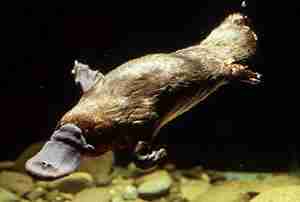 platypus
 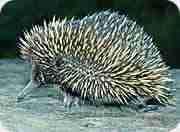 echidna
 platypus
  echidna
an anteater
Marsupials they are mammals whose young are born very immature. Most females have a pouch in which they rear their young.
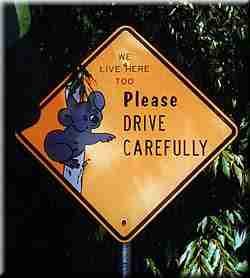 koala
koala 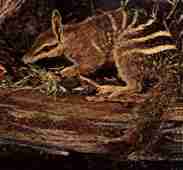 numbat
 koala
koala  numbat
pouchless, anteater
Flightless birds they evolved from birds that could fly because they had few predators from which they needed to escape.
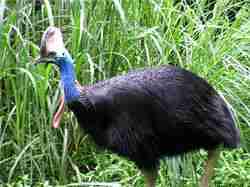 cassowary
 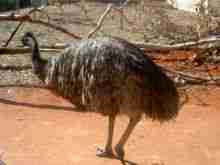 emu
emu
 cassowary
  emu
emua frugivore bird it can run up to 50km per hour
Rabbits and Toads
Rabbits 

In 1859 Thomas Austin brought out 24 rabbits and released them on his property for hunting purposes. Within 10 years, two millions could be shot without having any noticeable effect on their population. They compete with native wildlife and are responsible for the extinction of many plant and animal species.
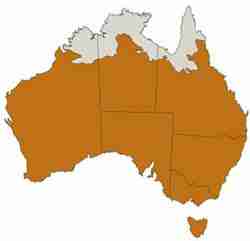 distribution of wild rabbits (the brown part)
 distribution of wild rabbits (the brown part)
Cane toads
They were introduced in 1935 to control insects that were destroying sugarcane crops. There are over 200 million of them now.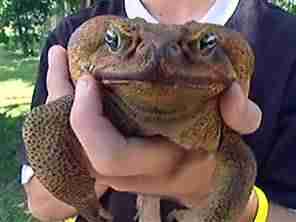 Some of them are growing. They can reach over 4kg the size of a little dog.
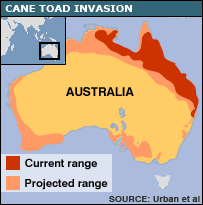 They were supposed to be a solution to a problem, now they are the problem.
 Some of them are growing. They can reach over 4kg the size of a little dog.
 They were supposed to be a solution to a problem, now they are the problem.
The aborigines
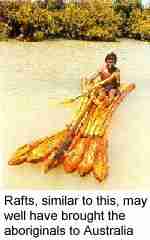 They migrated from somewhere in Asia. The aborigines' culture goes back at least 50,000 years. They have strong spiritual beliefs that tie them to the land. They were hunter-gatherers and respected the environment.
 They migrated from somewhere in Asia. The aborigines' culture goes back at least 50,000 years. They have strong spiritual beliefs that tie them to the land. They were hunter-gatherers and respected the environment.
Very old rock carvings can be found.
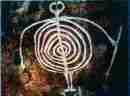
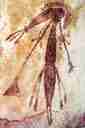
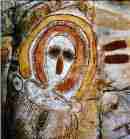
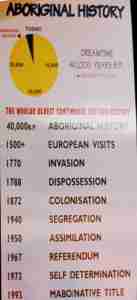 They have had a difficult colonial history.
 They have had a difficult colonial history.
The aboriginal flag
 It was designed in 1971 by an aboriginal artist Harold Thomas.
 It was designed in 1971 by an aboriginal artist Harold Thomas.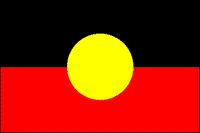
The black represents the people
The red stands for the earth
The yellow symbolizes the sun, the giver of life
 Twitter Share
English exercise "Australia" created by lili73 with The test builder. [More lessons & exercises from lili73]
Click here to see the current stats of this English test
 Please log in to save your progress.
End of the free exercise to learn English: Australia
A free English exercise to learn English.
Other English exercises on the same topic : Countries and nationalities | All our lessons and exercises
