





 |
|
|
|
|
|
|
|
|
|
| ||||||||||||||||||||||||||||||||||||
|
||||||||||||||||||||||||||||||||||||||||||||||
| Sport,
leisure, food and drink |
||||||||||||||||||||||||||||||||||||||||||||||
|
20 What is the most popular food in
Britain? 20 What is the most
popular food in Britain? The best-known British dish eaten at
home has been roast beef, traditionally eaten on Sunday. The dish used to
be so popular in England that the French still refer to the British as
‘les rosbifs’!
21 Why do the
British like drinking tea? Gradually, tea-drinking developed
into a fashionable social ritual and tea gardens blossomed in places like
Vauxhall and Marylebone in London, where couples could stroll in the
afternoon and enjoy a cup of tea with bread and butter and cakes. Tea
parties were also popular at home, and soon the ritual of ‘afternoon tea’
was firmly established. Today, throughout the homes, tea-shops and hotels
of Britain, the custom of tea-time continues, and it remains a feature of
any cricket match or summer fête. High Tea is a more substantial evening
meal, popular in northern England and Scotland.
Haggis is Scotland’s best-known regional dish, a rich, spicy concoction made from lamb’s offal (lungs, liver and heart) mixed with suet, onions, herbs and spices, all packed into a skin made of plastic, or, traditionally, a sheep’s stomach. Traditionally served on Burns’ Night, the haggis is often accompanied by mashed potatoes and mashed swede or turnips. Although the haggis neither sounds nor looks appetising, most people brave enough to try it agree that it is extremely tasty!
23 Is it true that a lot of British dishes are named after places? The rich variety of British regional cooking is reflected in the names of our favourite dishes. Many regions have their own particular speciality of sweet or savoury fare, or are famed for their local produce. Cheeses are produced in many regions, although Cheddar cheese, a strong-flavoured, salty cheese is the most popular variety. It originates from a village in Somerset in western England, also famous for its gorge. Other types of cheeses include Cheshire, Lancashire, Stilton and Wensleydale. Cornwall in south-west England is famous for its Cornish Pasties - a pastry case filled with meat, potatoes and vegetables, which was the traditional midday meal of workers in the region. The town of Bakewell in Derbyshire
has a rich pastry tart named after it. The Bakewell pudding or Bakewell
tart was said to have been invented by accident, when a cook forgot to put
jam over the custard filling of a pudding - instead she spread it straight
onto the pastry case and poured the custard on top. Thus a new dish was
born! Many other dishes are named after
places - everything from Lancashire hotpot (a casserole of meat and
vegetables topped with sliced potatoes) and Scottish shortbread (a sweet,
buttery biscuit) to Welsh rarebit (nothing to do with rabbit, but melted
cheese on toast!), baked Ulster ham, and Bath buns (a sweet bun containing
spices and dried fruit, originally made in Bath, western England). Indeed,
dedicated gourmets could happily munch their way from one county to
another!
24 Where can I look up the rules of cricket?
25 Where can I find out about the origins of British football clubs? For information about English clubs write to:
The respective organisations in Scotland, Wales and Northern Ireland are:
26 Why does Britain have four teams in international sporting tournaments?
27 What are the origins of the Wimbledon tennis championships?
Today Wimbledon fortnight takes place in June each year, with most of the world’s top-class tennis players competing for honours. During Wimbledon fortnight over 12 tons of salmon, 23 tons of strawberries and 285,000 cups of tea are supplied by caterers, together with 12,500 bottles of champagne! Tickets for Wimbledon are issued to the general public by ballot.
28 What are the Highland Games? The popularity of the Highland Games
dates back to Queen Victoria’s patronage of them, which began in the
middle of the last century, although before that time many Highland clans
had long held annual gatherings which included traditional sports and
games.
29 How do the British spend their leisure time? Britain’s most common leisure
activities are home-based or social. Watching television and videos, and
listening to the radio are by far the most popular leisure pastimes, with
an average of 20 hours a week devoted to these. Britain’s regular weekly
dramas or ‘soap operas’ such as ‘EastEnders’ and ‘Coronation Street’ have
more viewers than any other programme. The most common free-time activity outside the home amongst adults is a visit to the pub. Other popular leisure activities include visits to the theatre or cinema. There are over 1,500 cinemas in Britain, and in 1995 nearly one in five adults visited the cinema two or three times. Britain also has about 300 theatres, of which about 100 are in London. Britain’s most famous theatre company, The Royal Shakespeare Company, performs in Stratford-upon-Avon, Shakespeare’s birthplace, and in London. Of all sporting activities, walking
is by far the most popular for men and women of all ages. Whilst men tend
to dominate golf and cue sports such as snooker and billiards, women
generally prefer swimming, keep-fit classes and yoga.
30 Why do the British like going to the pub? One of the main attractions of the pub for all regular pubgoers is that it offers good company in friendly surroundings. Where else can you appear as a complete stranger and at once be able to join in a conversation with a diverse group of people? Often the style of the pub and its locality will dictate the kind of clientele you can expect to find there. Village pubs with their country furnishings and real ales attract not only local folk but citydwellers out for a drive, hikers fresh from a long day’s walk and pensioners enjoying a pub lunch. City pubs tend to have a more mixed clientele - businessmen and women discussing the latest deal, theatregoers or groups of friends enjoying a drink together before going off to a restaurant or nightclub. Good conversation and good beer are
two essential items provided by the pub. The drinking of beer in a public
house is not compulsory, but as any publican will tell you, beer remains
the mainstay of the trade. It is said that beer is the perfect drink for
the pub - it comes in large measures (one pint glasses) so that just one
drink provides plenty of conversation time! Many pubs also serve food,
from snacks to full meals.
31 What and when are the Proms?
The Proms take place each year, from mid-July to mid-September, although the most popular evening is the Last Night of the Proms, when concert goers fill the Hall and stand tightly packed in the arena in front of the orchestra for an evening of stirring music. A proms guide for the current year’s concerts is available from May in large bookshops, or it can be ordered from:
In addition to possessing a thriving interest in classical music, British music lovers have a passion for all other areas of music, from opera to folk and jazz, from rock to the latest chart topping pop group.
The British sense of humour is often a source of mystification for
other nations, and visitors to Britain may claim that our humour is
incomprehensible; however, possessing ‘a sense of humour’ is usually
regarded as a favourite virtue of the British. Bawdy or slapstick comedy can trace its roots back to Chaucer and
Shakespeare, and continued through the early films of Charlie Chaplin, the
‘Carry On’ film series of the 1960s and 1970s and is found today in
characters such as Rick and Eddie in the television comedy ‘Bottom’,
played by Rik Mayall and Adrian Edmonson, or the long-running ‘Benny Hill
Show’. Finally, British humour has an everpresent but hard to define
appreciation of the absurd, originating in programmes like ‘The Goon
Show’, a radio comedy of the 1950s starring comedians Michael Bentine
(1922-1996), Peter Sellers (1925-1980), Spike Milligan (b. 1918) and Harry
Secombe (b. 1921) and continuing in television’s legendary ‘Monty Python’s
Flying Circus’ and ‘Fawlty Towers’.
33 What is the Edinburgh Festival? The Edinburgh Festival is an annual arts festival held in Edinburgh
during August and September. The Festival, first held in 1947, has gained
an international reputation, and is widely recognised for providing
opportunities for avant-garde theatre groups and emerging new talents to
showcase their work as part of the Edinburgh Fringe - performances staged
at smaller venues and theatres outside the main programme of events, often
of a more experimental, ‘offbeat’ nature.The quality of the Festival’s
professional productions of music and theatre attract an international
audience, and it is widely acknowledged that every hotel and guest house
in the city is full to capacity during the festival months.
|
               |
|||||||||||||||||||||||||||||||||||||||||||||
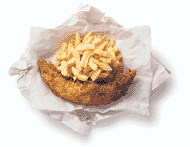 Britain’s most popular ‘fast food’ has got to be fish and chips.
 Wisden Cricketer’s Almanack, published
annually
Wisden Cricketer’s Almanack, published
annually  In
some international sporting tournaments, including hockey, football and
athletics (Commonwealth Games) Britain sends four separate teams,
representing the countries of England, Scotland, Wales and Northern
Ireland.
In
some international sporting tournaments, including hockey, football and
athletics (Commonwealth Games) Britain sends four separate teams,
representing the countries of England, Scotland, Wales and Northern
Ireland. The famous international tennis tournament at Wimbledon in
south west London had humble beginnings as a small championship
competition for
The famous international tennis tournament at Wimbledon in
south west London had humble beginnings as a small championship
competition for  Other
attractions offered by city and country pubs alike include a game of darts
(short, weighted steel darts are thrown at a circular dartboard numbered
in sections) and snooker, a game similar to billiards.
Other
attractions offered by city and country pubs alike include a game of darts
(short, weighted steel darts are thrown at a circular dartboard numbered
in sections) and snooker, a game similar to billiards. The Proms or Promenade Concerts are an annual series of
music concerts sponsored by the BBC and held at the Royal Albert Hall and
other venues in London. They are called ‘Promenade Concerts’ because
originally the audience ‘promenaded’ or walked about during the concerts,
although now they stand or sit.The Proms originated in 1895, and since
that time have become a hugely popular event. The programmes are usually
of classical music, and reflect popular taste as well as more original and
adventurous pieces. These days jazz, world music and other musical styles
also feature on the concert programme.
The Proms or Promenade Concerts are an annual series of
music concerts sponsored by the BBC and held at the Royal Albert Hall and
other venues in London. They are called ‘Promenade Concerts’ because
originally the audience ‘promenaded’ or walked about during the concerts,
although now they stand or sit.The Proms originated in 1895, and since
that time have become a hugely popular event. The programmes are usually
of classical music, and reflect popular taste as well as more original and
adventurous pieces. These days jazz, world music and other musical styles
also feature on the concert programme.
